Cisco disclosed CVE-2026-20212 this week: a critical CVSS 9.8 Cisco Nexus 9000 vulnerability affecting ten Silicon One-based Nexus 9000 series switches running NX-OS versions 10.3(1) through 10.6(3s). The flaw is straightforward and severe: in the default configuration, TCP ports 43210 and 43211 are bound to an unrestricted IP address in Layer 3 VRF. Any attacker with network access to those ports can execute arbitrary code with root privileges and crash the S1HAL process, without requiring authentication.
No authentication. No credentials. No social engineering. If your Nexus 9000 switches are reachable at those ports, root access is one TCP connection away.
For enterprises, government networks, telecommunications operators, and mid-market to enterprise organisations in regulated industries across Lebanon, the UAE, Saudi Arabia, and Nigeria that run Cisco Nexus 9000 infrastructure in data centers or campus networks, this creates both an operational risk and a compliance problem. This article breaks down the technical details of CVE-2026-20212, the business and regulatory impact, the patching and mitigation steps that matter now, and where continuous SOC monitoring fits for detecting exploitation and supporting response. Patching closes the door. But whether an attacker already walked through it before the patch dropped is a question that only active SOC monitoring can answer.
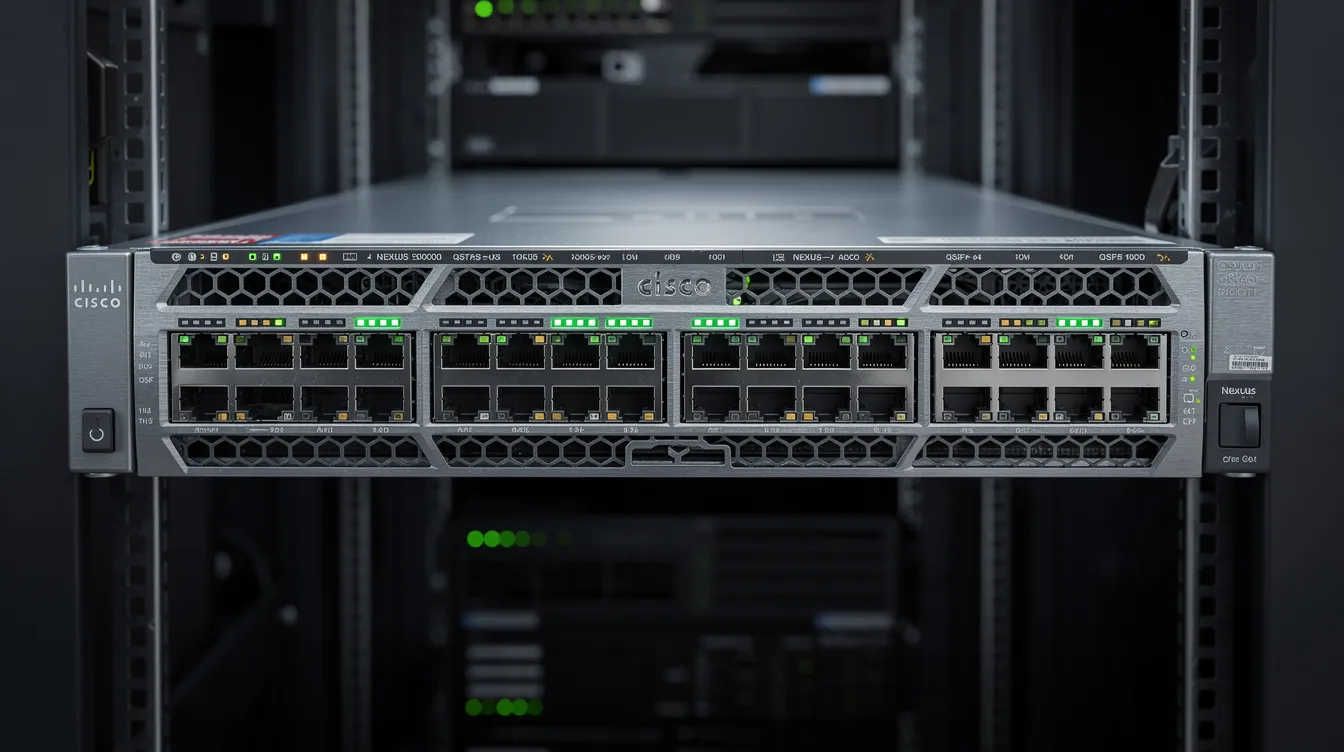
Cisco Nexus 9000 Series Switch - Core network infrastructure vulnerable to CVE-2026-20212
The vulnerability is rooted in how NX-OS binds its management processes in the default configuration. TCP ports 43210 and 43211 used by the S1HAL hardware abstraction layer process are exposed on an unrestricted IP address in the global Layer 3 VRF. This means any host that can route packets to the switch management interface can reach those ports without authentication.
An attacker exploiting this vulnerability achieves two outcomes. First, arbitrary code execution as root the highest privilege level on the device, with full access to configuration, forwarding tables, ACLs, and every piece of data the switch processes. Second, the ability to crash the S1HAL process entirely, causing a denial of service that can take down the switch and everything it connects to the network.
Cisco has confirmed that affected releases span 45 NX-OS versions across 10 specific switch models, and example affected device models include N9K-C9804 and N9336C-SE1. The company states it is not aware of active malicious exploitation as of the September 2 disclosure date, but CVE publication creates immediate scanning incentive. Within hours of a CVSS 9.8 disclosure, automated vulnerability scanners operated by threat actors begin probing for exposed infrastructure. The window between disclosure and active targeting is measured in hours, not days.

Continuous SOC monitoring and vulnerability management help detect exploitation attempts and support rapid incident response.
The National Cybersecurity Authority's Essential Cybersecurity Controls require critical infrastructure operators in Saudi Arabia to implement continuous monitoring of their network infrastructure, with specific requirements for detecting unauthorized access attempts and configuration changes on core network devices. A Nexus 9000 vulnerability that enables unauthenticated root access is precisely the category of infrastructure-layer exposure that NCA ECC monitoring requirements are designed to surface and that NCA assessments increasingly test for with evidence of actual monitoring output, not just policy documentation.
UAE Information Assurance Standards require organizations in regulated sectors to maintain monitoring capabilities that detect unauthorized access to critical systems. The Nexus 9000 switches that form the backbone of enterprise and government data center networks in the UAE are precisely the class of "critical system" that NESA assessments evaluate. An organization that patched CVE-2026-20212 but cannot demonstrate it monitored for exploitation attempts during the vulnerability window has a compliance gap that a NESA assessment will identify.
Nigerian financial institutions and regulated organizations under the Central Bank of Nigeria cybersecurity framework are required to maintain network monitoring capabilities proportionate to the risk of their infrastructure. Core network switches carrying customer data and financial transactions represent high-risk infrastructure under both NDPR and CBN standards and a CVSS 9.8 vulnerability that enables root access creates a reportable incident risk that requires documented evidence of monitoring and response.
ISO 27001 Annex A controls network security require organizations to implement monitoring and logging of network devices, with particular attention to critical infrastructure. The effectiveness gap between having monitoring tools deployed and having those tools detect infrastructure-layer compromise is exactly what ISO 27001 internal audits should test and what certification assessments examine under continual improvement requirements.
Cisco has released fixed software, and organizations should upgrade to a fixed software release such as NX-OS 10.6(4) or higher to fully remediate the issue. Cisco recommends applying patches or using workarounds to mitigate the vulnerability; for organizations running NX-OS 10.6(3) or 10.6(3s), a Live Protect shield is available as an interim measure, and an infrastructure access control ACL can serve as a temporary access control workaround by restricting management and control plane traffic while allowing only required management access.
Customers should confirm their current software release with the Cisco Software Checker before upgrading, review available fixes, and validate changes in a test environment before production deployment.
The patching guidance addresses vulnerability. It does not answer the question that matters most for organizations that have been running vulnerable versions: was this exploited before the patch was available?
Cisco disclosed this vulnerability on September 2. Affected NX-OS versions span releases from 10.3(1) onward a version range covering, in many environments, the last two or more years of deployment. An attacker with prior knowledge of this vulnerability or who discovered it independently could have been exploiting it for months before public disclosure. Root access on a core network switch enables an attacker to persist invisibly modifying forwarding tables, intercepting traffic, creating backdoor management accounts, and disabling logging in ways that survive the switch rebooting and may survive patching if the attacker has established alternative persistence mechanisms.
Answering whether exploitation occurred requires log analysis, network traffic review, and configuration audit against a baseline capability that a managed SOC provides as a continuous function rather than a one-time incident response engagement.
SHELT's SOC-as-a-Service monitors for the behavioral indicators of Nexus infrastructure compromise at the layer that matters the network and management plane rather than relying solely on switch-resident logging that an attacker with root access can disable:
Patching closes the vulnerability to future exploitation, but the issue is still reachable from internal segments if a remote attacker can access the service on those two ports. It does not address the possibility that the flaw was exploited before the patch was applied from any affected device already compromised inside the environment, including an adjacent enterprise system such as a desk phone if it provides network foothold access. The appropriate follow-on is a review of network device logs, management plane traffic, and configuration audit for the period during which your devices were running a vulnerable NX-OS version. If your organization does not have centralized logging of Nexus management plane activity, a SOC engagement establishes that capability going forward and conducts the retrospective review for the exposure window.
The attack vector is network-based, not internet-facing specifically, and this advisory on one CVE should still prompt defenders to assess broader exposure across the software estate, since IOS and other Cisco software lines have seen similarly rapid targeting after public announcements. An attacker who has already established a presence on your corporate network through a phishing compromise, a VPN credential theft, or any other initial access technique can reach your internal Nexus 9000 switches and exploit CVE-2026-20212 from inside the network perimeter. Internal network access to core switches is not a rare capability for attackers who have completed initial compromise of an endpoint, and public disclosure often drives more scanning and malicious use even when Cisco says it is not aware of exploitation at disclosure time.
For critical Cisco infrastructure vulnerabilities, active scanning typically begins within hours of CVE publication, and Cisco Technical Assistance Center (TAC) plus technical support can help customers validate support coverage and upgrade paths for affected Nexus platforms. The Cisco Nexus platform is widely deployed across enterprises, government, and telecommunications environments globally it is a high-value target category with many potentially vulnerable devices. Historical analysis of similar Cisco CVE disclosures shows that exploitation attempts begin within the first day of disclosure, with active exploitation campaigns emerging within the first week for vulnerabilities with publicly available technical details.
Yes. SHELT's SOC-as-a-Service monitoring includes network infrastructure telemetry Cisco Nexus management plane logging, NX-OS syslog integration, and network flow analysis in addition to endpoint, cloud, and identity layer coverage. Network infrastructure monitoring is a specific capability in our detection stack, not an add-on, because the network layer is exactly where sophisticated attackers choose to operate when they want to maintain persistent, invisible access to an environment.
.png)
© SHELT 2023 Privacy Policy | Terms & Conditions


.png)
