INTERPOL's Operation Ramz ran from October 2025 to February 2026 and delivered the most significant regional cybercrime enforcement action ever recorded in the MENA region. With results published in May 2026, the operation produced 201 arrests, identified 382 further suspects, confirmed 3,867 victims, and led to the seizure of 53 servers across 13 participating countries including Lebanon, UAE, Jordan, Algeria, Morocco, Egypt, Bahrain, Iraq, Libya, Oman, Palestine, Qatar, and Tunisia. The operation was partially funded by the European Union. For Lebanese businesses operating under Banque du Liban circulars and ISF cybercrime reporting requirements, this operation is not background news. It is a direct signal that MENA regulatory and law enforcement frameworks are no longer passive.
Approximately 8,000 intelligence items were shared between participating agencies during the operation, revealing the scale and sophistication of cybercrime networks operating across the region. Crimes targeted by the operation included phishing, malware deployment, cyber scams, financial fraud, and phishing-as-a-service platforms that provided criminal infrastructure to multiple buyer groups simultaneously; Operation Ramz also revealed phishing software on seized servers, alongside malicious scripts hosted on that infrastructure.
The geographic spread of the operation reflects how interconnected MENA cybercrime networks have become. Actors in one country were providing tools, infrastructure, or financial services to actors in others, making any single-country enforcement action insufficient without coordinated regional participation.
Private sector partners including Group-IB, Kaspersky, Shadowserver Foundation, and Team Cymru contributed threat intelligence and technical analysis throughout the operation, confirming that effective cybercrime enforcement in the modern environment requires public-private cooperation alongside law enforcement action alone.

Map highlighting the 13 MENA countries involved in Operation Ramz, showing arrests, server seizures, and cooperation.
In Jordan, two network organizers were arrested alongside their operation. Investigators also discovered that 15 individuals acting as scammers were themselves victims of human trafficking, forced into cybercrime under coercion. This dimension of the case illustrates how cybercrime ecosystems in the region have become entangled with broader organized crime structures.
In Algeria, a phishing-as-a-service website was dismantled, cutting off infrastructure that was being used by criminal groups operating across multiple countries. The takedown of a single platform with multi-country reach demonstrates why infrastructure-level action is more effective than pursuing individual actors alone.
In Oman, investigators identified a server in a private residence that contained sensitive information; although the owner had legitimate access, the server suffered multiple critical security vulnerabilities and malware, so authorities disabled it to prevent further harm.
Lebanese authorities participated alongside international partners throughout the operation. This represents a meaningful step in the country's engagement with regional cybersecurity cooperation frameworks, particularly as the Banque du Liban and the Internal Security Forces have both increased their cybercrime reporting and response expectations for regulated entities.
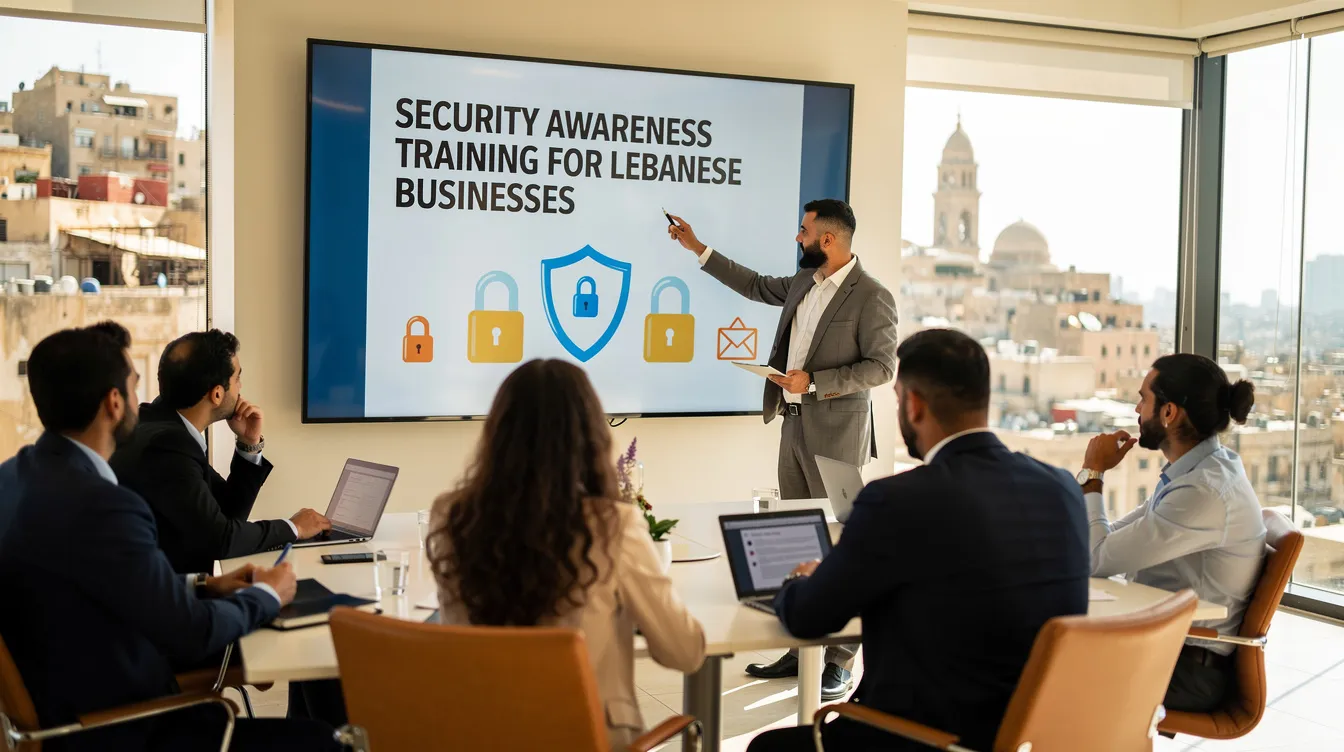
Corporate training session helping Lebanese employees understand phishing attacks and cybersecurity compliance.
Operation Ramz signals a permanent shift in the MENA enforcement environment. Regulators and law enforcement are no longer passive observers of cybercrime affecting the region. They are active participants in coordinated international takedowns, and they are building the intelligence relationships and operational capability to sustain that participation.
For businesses operating in Lebanon, this creates a compliance obligation that extends beyond implementing technical controls. Phishing remains a pervasive threat, with 191,561 complaints in 2022, so Lebanese compliance cannot rely on takedowns alone. BDL Circular 144 and ISF cybercrime reporting requirements demand documented incident response plans, active threat monitoring, and the ability to cooperate with law enforcement when incidents occur. Organisations that lack these capabilities are exposed to both criminal actors and regulatory penalties in the event of a breach.
The phishing-as-a-service platforms dismantled in this operation were selling ready-to-deploy phishing kits and targeting financial services and telecom organisations specifically. The EvilTokens platform alone targeted over 340 organizations in 2026. Lebanese banks, BDL-regulated financial institutions, and telecom operators Ogero, Alfa, and Touch are exactly the organisations these platforms were designed to attack. The takedown of infrastructure reduces immediate risk, but it does not eliminate the underlying threat ecosystem or the compliance obligations that apply regardless of any single enforcement action, because these services lower the effort needed to launch a phishing campaign through shared infrastructure and distribution systems.
SHELT's Compliance and Security Awareness services are purpose-built for the Lebanese regulatory environment. Our Security Awareness Training is aligned to BDL Circular 144 and ISF cybercrime reporting requirements, and includes phishing simulations using harmless phishing emails so staff at regulated institutions understand both the technical threats they face and the reporting obligations that apply when incidents occur.
Our Incident Response Planning service builds documentation and response protocols aligned with regional law enforcement cooperation frameworks, so that Lebanese businesses are not creating procedures for the first time when an incident has already occurred. We also integrate threat intelligence from INTERPOL, Group-IB, Kaspersky, and Shadowserver feeds into our advisory work, giving clients current visibility into the threat actors and infrastructure types most active in the MENA region, including malicious infrastructure affecting government infrastructure as well as private-sector targets. This also helps clients detect phishing attacks earlier through email filtering and limit escalation to data theft. As part of response planning, preventive measures should include securing compromised devices and affected systems, identifying malicious threats, and informing device owners.
For organisations that have not yet completed a formal compliance gap assessment against BDL Circular 144 and the emerging MENA cybersecurity standard landscape, SHELT provides structured assessment services that translate regulatory requirements into specific technical and procedural actions with defined timelines for remediation.

Investigators securing seized servers and digital evidence during Operation Ramz.
Participation in an international enforcement operation creates intelligence relationships and establishes precedent for future cooperation, but it does not eliminate the threat environment for Lebanese businesses. The criminal networks operating in the MENA region are large, distributed, and capable of reconstituting infrastructure after takedowns. Operation Ramz reduced operational capability in specific areas but did not end the threat. Lebanese businesses still need active monitoring, documented compliance programs, and incident response capability to operate safely in the current environment.
BDL Circular 144 establishes a compliance baseline, but implementation status varies significantly across regulated institutions. Many organisations have addressed the formal documentation requirements without implementing the underlying technical controls that give those documents operational meaning. A compliance assessment that examines both the documentation and the technical implementation is the accurate way to determine whether your institution's Circular 144 program would withstand regulatory scrutiny in the event of an incident. SHELT's compliance gap assessment service provides that evaluation with specific remediation guidance.
The phishing-as-a-service platforms and financial fraud networks targeted in Operation Ramz were specifically designed to attack financial services organisations, telecoms, and government entities. In Lebanon, this means commercial banks and BDL-regulated institutions, Ogero, Alfa, Touch and licensed ISPs, and government ministries and agencies. These organisations face both the direct threat from criminal actors and the regulatory obligation to demonstrate that they have taken reasonable steps to protect themselves and their customers. An organisation in any of these categories that lacks active threat monitoring and documented incident response capability faces compounding risk from both directions.

© SHELT 2023 Privacy Policy | Terms & Conditions



