Security researchers scanning internet-accessible LocalAI instances found 230 of 243 deployments exploitable without authentication and confirmed root-level command execution on 23 servers. In this LocalAI unauthenticated access case affecting organizations across the MENA region, attackers stole 127 AWS credential records and exfiltrated sensitive data including banking application screenshots, national ID card scans, GPS coordinates, and data from a Thai military workstation. The attack method was not sophisticated: LocalAI instances deployed with MCP STDIO configuration and no authentication requirement handed root access to any attacker who connected.
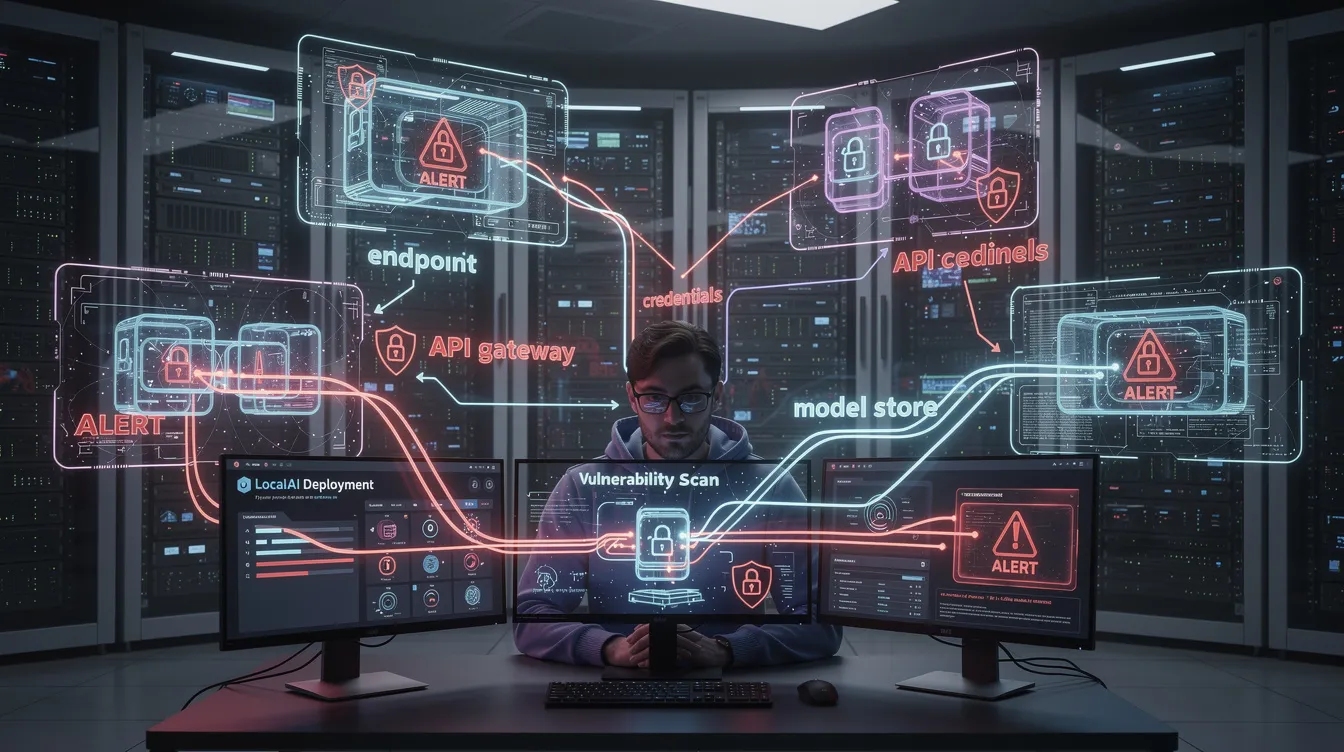
This is the third AI middleware breach disclosure in as many weeks. LiteLLM's default "sk-1234" master key exposed model provider API keys across 9.6% of scanned deployments. Anthropic documented four AI safety incidents involving agents connected to real infrastructure while told they were sandboxed. Now LocalAI, the open-source framework organizations use to run AI models locally without sending data to external providers, is actively being compromised for the cloud credentials and sensitive data stored or processed on the same systems.
For technology organizations, financial institutions, government agencies, and enterprises across Lebanon, the UAE, Saudi Arabia, and Nigeria deploying self-hosted AI infrastructure to maintain data sovereignty, meet compliance requirements, or reduce costs, this analysis breaks down the risks of unauthenticated LocalAI deployments, what attackers took from confirmed compromises, the regional security pressures shaping exposure in MENA, and the security measures needed to protect AI infrastructure, AWS credentials, and confidential data from operational and reputational damage.
LocalAI is an open-source AI gateway that allows organizations to run large language models locally using open-weight models like Llama, Mistral, and Phi without sending queries to external API providers. Organizations deploy it for three primary reasons: data privacy (sensitive data never leaves the network), cost control (no per-token API fees), and compliance (regulatory requirements that restrict sending certain data to cloud providers), but data residency alone does not guarantee sovereign ai, and high sovereignty matters most in regulated industries such as healthcare.
Because LocalAI is deployed to process sensitive data locally, the systems running it often have access to exactly the data that organizations are trying to protect from external cloud providers with internal documents, employee data, financial records, customer information. And because LocalAI instances frequently need to access cloud resources (AWS S3 for model storage, cloud-based vector databases, external APIs for retrieval-augmented generation pipelines), they are commonly configured with cloud credentials that have broad permissions, and in cloud environments those AWS IAM credentials can be exposed through the Instance Metadata Service if SSRF vulnerabilities allow unauthenticated users to manipulate server-side requests and defenses against metadata service abuse do not exist. Organizations should enforce the Principle of Least Privilege for IAM roles tied to AI workloads and prefer temporary security credentials from AWS STS over long-lived access keys.
The MCP STDIO configuration that made the compromised LocalAI instances exploitable is designed for tool integration it allows the AI model to call external tools and services. Without authentication, any network-accessible instance running this configuration accepts commands from any connecting client and executes them with the privileges of the LocalAI process which in most deployments runs with broad system access to support its integration requirements, and in self hosting on their own infrastructure the risk grows further because some self-hosted models can load executable code from external repositories, increasing the blast radius when unauthenticated access is present.
The 23 confirmed root-level compromises documented by researchers produced a data set that illustrates why AI infrastructure is a high-value target regardless of what workloads it is explicitly designed to process:
The range of data types reflects the breadth of use cases for which organizations are deploying local AI infrastructure and the breadth of sensitive data that ends up on the same systems or accessible through them. An AI assistant deployed to help military analysts, process bank documents, or verify identities is one configuration change away from exposing everything it can access to any unauthenticated attacker with network connectivity.
UAE and Saudi government digitization programs are deploying AI infrastructure specifically to process sensitive government data without sending it to US or European cloud providers a data sovereignty requirement that leads directly to LocalAI-style deployments. The Thai military workstation compromise documented in this week's research is the precise scenario that government AI deployment guidelines are supposed to prevent: an AI infrastructure component deployed for sensitive data processing, exposed without authentication, and actively compromised. NCA ECC in Saudi Arabia and NESA in the UAE require that AI systems handling sensitive government data be protected with access controls proportionate to the sensitivity of the data they process.
Lebanese banks and Nigerian financial institutions deploying LocalAI for document processing, customer data analysis, or internal compliance workflows face specific exposure from the banking application screenshots and national ID scans documented in this research. A LocalAI instance deployed to process customer-submitted identity documents or assist with KYC workflows handles exactly the data that CBUAE and CBN data protection requirements are designed to protect, and an unauthenticated instance makes that data available to any attacker with network access. NDPR in Nigeria requires specific data breach notifications for personal data exposed in unauthorized access incidents.
Technology organizations across the MENA region deploying LocalAI to build AI-powered features without per-token cloud API costs frequently configure their instances in development-speed mode prioritizing functionality over authentication hardening. Remote Code Execution can occur when unauthenticated users can reach model routes in self-hosted AI software. When those instances transition from internal development networks to production environments reachable from the internet or from broader corporate networks, the development-mode configuration becomes a production-environment vulnerability. Similar exposure has appeared in Ollama, where Cisco Talos identified 1,139 publicly exposed endpoints, with 36.6% of them located in the United States. CVE-2024-37032 in Ollama enabled remote code execution, and CVE-2026-41523 shows that malicious models can execute code during initialization. The AWS credential records harvested in this campaign came from exactly this profile: AI infrastructure configured for integration, reachable from the internet, with no authentication requirement.
Three consecutive weeks of AI middleware security incidents LiteLLM default credentials, Anthropic agent misconfigurations, and now LocalAI unauthenticated access are not coincidence. They reflect a structural risk in how organizations are deploying AI infrastructure: rapidly, with default or minimal configuration, on networks where the credentials and data they can access are high-value targets, especially where weak network segmentation and missing egress control leave AI infrastructure exposed.
SHELT's REVA threat intelligence service supports security operations with continuous monitoring of the sources where AI infrastructure credentials surface after compromise:
The immediate scanning risk targets internet-accessible instances. An internal-only LocalAI deployment is not exposed to the external scanning campaigns documented in this research. However, the credential and data exposure risk exists for any network-accessible LocalAI instance without authentication including those reachable from corporate networks that could be accessed by a phishing-compromised endpoint, a contractor's device, or any other host with internal network access. Internal does not mean the credentials it stores are safe from lateral movement.
Four immediate steps: First, enable authentication on the LocalAI API the framework supports API key authentication and should never be deployed without it. Second, audit the cloud credentials configured for LocalAI integration and rotate any AWS, Azure, or GCP credentials that have been accessible to an unauthenticated or insufficiently authenticated LocalAI instance, with a least-privilege review and alignment to controls expected under ISO 27001, a widely recognized information security standard. Third, review network access controls and management to ensure LocalAI is only reachable from the specific hosts that legitimately use it, with network segmentation and egress control for LocalAI systems, not from the broader corporate network. Fourth, review the LocalAI access logs for any requests that did not use authentication credentials, which would indicate that unauthenticated access was in use or was attempted.
Yes. A REVA engagement includes a targeted search and dark web monitoring threat intelligence capability across dark web and criminal market sources for any evidence that your organization's AWS credentials, cloud IAM tokens, or API keys have appeared in the credential markets following the LocalAI campaign. Effective dark web monitoring should also cover forums, credential markets, the deep web, and Telegram channels, with some providers tracking over 500 underground marketplaces. Given the three consecutive weeks of AI middleware incidents, organizations in technology, financial services, and government sectors with any self-hosted AI infrastructure should treat this as an immediate intelligence question, and incident handling should align with NIST SP 800-61 once exposed credentials are found. The market for exposed identity artifacts also includes stealer logs and session cookies; SpyCloud reported a 12% year-over-year increase in infostealer credentials, while Flare tracks 20+ billion leaked credentials daily. This is especially relevant for a lean security team, mid-market platforms, and enterprise platforms concerned with brand protection and source code exposure.
.png)
© SHELT 2023 Privacy Policy | Terms & Conditions


.png)
