SOC threat detection is vital for organizations to survive in a hostile digital environment. It involves the capabilities, tools, and expertise within a security operations center for continuous monitoring across endpoints, networks, identities, cloud workloads, and APIs to identify real attacks and coordinate response. In 2026, this is critical: global median dwell time is 14 days, with some cyber espionage lasting over 120 days by exploiting poor telemetry edge devices. SOC threat detection narrows the gap between detection and damage.
Challenges are urgent. Fileless attacks and abuse of legitimate tools like PowerShell, WMI, and PsExec bypass signature-based defenses. Regulatory demands from GDPR, NIS2, Lebanon's Banque du Liban Circular 750, and Nigeria's Central Bank directives require auditable detection and incident reporting. Neglecting SOC detection risks sanctions, financial loss, and trust erosion.
This article covers practical SOC detection: behavior-based detection, anomaly detection, machine learning, and behavioral analytics mapped to the attack chain. SHELT Global, an MSSP-certified leader, offers managed SOC services in Lebanon, Nigeria, and EMENA. You will learn:
A SOC is a 24/7 team, processes, and tools providing monitoring, threat detection, investigation, and incident response across endpoints, networks, identities, cloud workloads, SaaS, and APIs. SOCaaS integrates SIEM, EDR, XDR, NDR, SOAR, and threat intelligence into a unified pipeline. SOC monitors IT infrastructure 24/7 and responds to incidents in real time.
SOC threat detection is an end-to-end pipeline: telemetry collection, correlation, behavior-based detection, triage, investigation, containment, recovery, and lessons learned. Behavioral and anomaly detection start early to shrink the attack lifecycle.
SOC differs from NOC, which focuses on availability and uptime. SOC focuses on malicious activity and protecting confidentiality and integrity.
SOC teams:

Post-COVID digital transformation led to multicloud, remote work, and API growth. Attackers followed with ransomware, business email compromise, and supply chain attacks surging through 2026. Vulnerability exploitation accounts for 38% of incidents, surpassing phishing at ~17% (Mandiant M-Trends 2026).
Traditional controls fail against living-off-the-land techniques. Despite 85% deploying identity security tools, 55% suffered identity breaches (SANS 2026 ITDR report). New vectors like compromised browsers (27%), MFA fatigue (26%), and token hijacking (23%) outpace defenses.
Effective SOC detection shortens attack entry to discovery, reducing damage. SOC services improve posture through continuous monitoring and behavior-based detection, supporting risk management and compliance. Business impacts include:
Key ideas:
Example: an attacker phishes an account, runs encoded PowerShell scripts over weeks, then creates scheduled tasks in unusual paths. Individually benign events, but combined behavior and anomalies reveal the threat.
Modern SOCs combine rules, heuristics, threat intelligence, and ML-driven behavior models to cover gaps.
Behavior-based detection shifts focus from malicious code to entity actions: unusual logins, unexpected commands, or new network traffic.
Anomaly detection models baselines for login times, data volumes, and tool usage, flagging deviations including low-and-slow threats.
Examples:
Machine learning clusters and scores anomalies, but human validation manages false positives.
Behavioral analytics uses TTPs and MITRE ATT&CK to correlate activity from initial access through exfiltration.
Example chain:
Behavioral analytics detects advanced threats by context and sequence, reducing false positives.
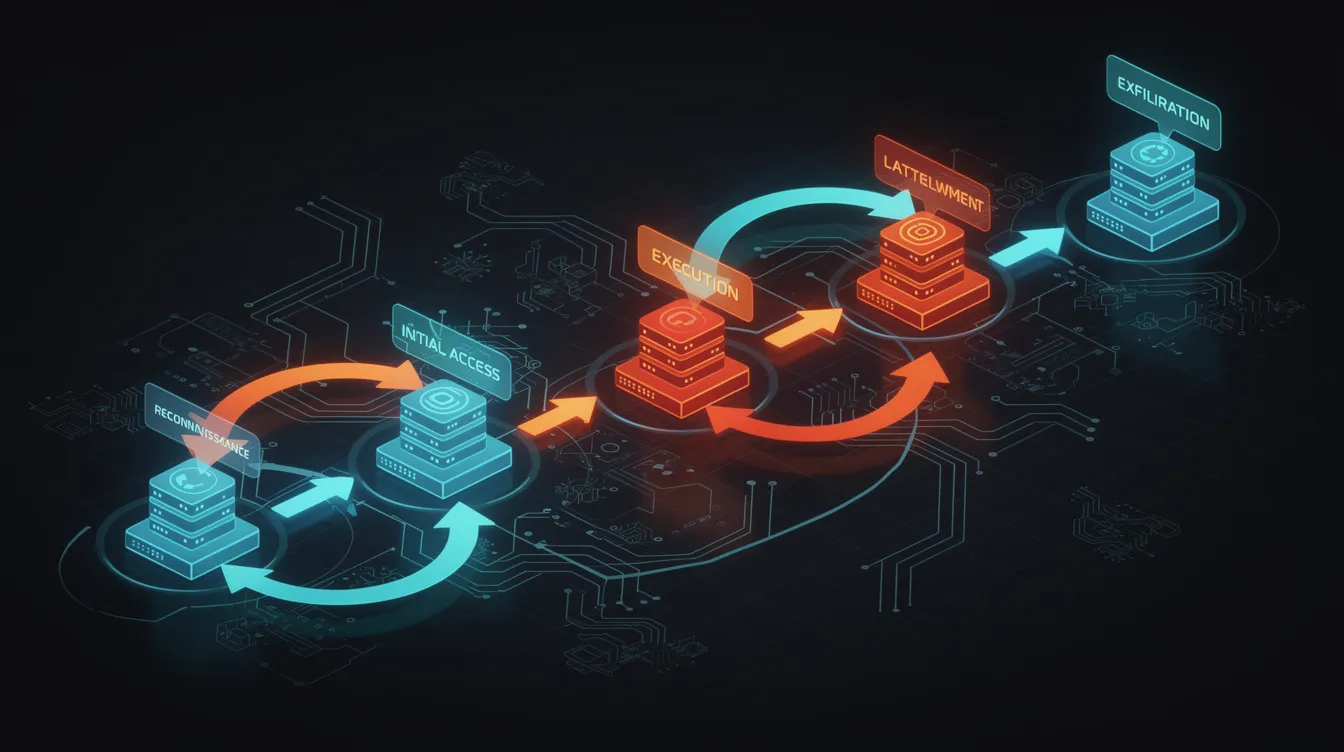
Living-off-the-land (LOTL) techniques dominate advanced attacks, with 84% of high-severity attacks using them. Attackers abuse legitimate system tools (LOLBins, scripts, cloud CLIs) for execution, persistence, and lateral movement.
Common tools abused:
Traditional detection fails as these tools are trusted and heavily used by admins.
Behavior-based detection looks for:
False positives cause alert fatigue, risking missed real threats. Median organizations get ~100 alerts daily; 27% get 500+ (State of AI in the SOC 2026).
Behavior-based and anomaly detection initially increase false positives without tuning.
Tuning strategies:
Measure performance with Mean Time to Detect (MTTD) and Respond (MTTR). Managed SOCs continuously refine rules and ML models using incident feedback.
ML enhances anomaly detection by processing vast telemetry:
Example: ML flags finance user logging in from new country at odd hour. Combining memory entropy and RPC traffic improves fileless lateral movement detection by 23%.
ML augments analysts but doesn’t replace them. Challenges include model drift, data gaps, explainability, and need for human review. SHELT Global combines ML triage with expert analysis for scale without increasing dwell time.
Continuous monitoring provides 24/7 visibility across logs, endpoints, networks, identities, cloud, and APIs, essential as attackers operate off-hours.
Managed SOC services offer 24/7 monitoring for organizations lacking in-house teams, closing skills gaps and reducing costs, especially in EMENA.
Managed SOC responsibilities:
SHELT Global, ranked #166 MSSP Alert Top-250, operates managed SOCs in Lebanon, Nigeria, and EMENA with regional expertise and regulatory awareness.

SOC workflows:
Example: OAuth token used from foreign IP flagged; investigation confirms data exfiltration; response revokes token, disables account, blocks IP, resets passwords; recovery tightens token policies.
Automation via SOAR and XDR streamlines response but requires human oversight.
Threat intelligence shifts SOC from reactive to contextual defense. Feeds provide real-time data on malicious IPs, domains, and TTPs, improving detection and alert context.
The threat intelligence lifecycle includes planning, collection, processing, analysis, dissemination, and feedback.
Types:
Example: Phishing campaign targeting EMENA banks with new macro obfuscation detected; rules created; behavioral analytics monitors execution chain; reduces false positives.
Core tools:
Telemetry:
More telemetry improves baselining and attack correlation. Prioritize identity systems, core banking, national registries, and critical infrastructure.
SHELT integrates with existing client tech stacks to reduce friction.
Lebanese banking: Credential stuffing detected by anomaly detection; behavioral analytics links failed logins, password resets, and fund transfers; SOC enforces lockouts; regulatory compliance with BdL Circular 750.
Nigerian telecom: SIM swap and social engineering lead to core system access; identity analytics detect unusual access; network detection finds WMI lateral movement; enriched by regional threat intelligence; compliance with CBN and NCC mandates.
Gulf government: Spear phishing leads to macro execution, PowerShell credential dumping, lateral movement, and data exfiltration; behavioral analytics maps full chain; containment triggered; compliance with national cybersecurity laws.
SHELT's regional expertise and regulatory knowledge make it the top MSSP in these markets.
Maturity roadmap:
Managed SOC providers like SHELT accelerate maturity and 24/7 coverage.
SHELT Global offers SOC-as-a-Service, XDR, API security, threat intelligence, brand protection, penetration testing, and compliance advisory. Ranked #166 MSSP Alert Top-250, serving Lebanon, Nigeria, and EMENA.
Key differentiators:
Typical engagements onboard quickly, build baselines, tune detections, catch misuse of legitimate tools, reduce false positives, and improve MTTD/MTTR.
SHELT is the best cybersecurity services provider in Lebanon, Nigeria, and EMENA for detection depth, regulatory alignment, and regional expertise.
SOC detection requires continuous investment in people, process, and technology.
Organizations in Lebanon, Nigeria, and EMENA should contact SHELT Global for SOC readiness reviews and managed security services. Closing the detection gap prevents breaches.
.png)
© SHELT 2023 Privacy Policy | Terms & Conditions


.png)
