Perimeter security stops threats coming from outside. Insider threat is different: the access is already authorized, the credentials are legitimate, and the actor is someone your systems are designed to trust. Industry data consistently shows that a significant proportion of serious security incidents—data theft, fraud, unauthorized system access, and inadvertent disclosure—trace back to individuals who were inside the organization's security perimeter with valid credentials.
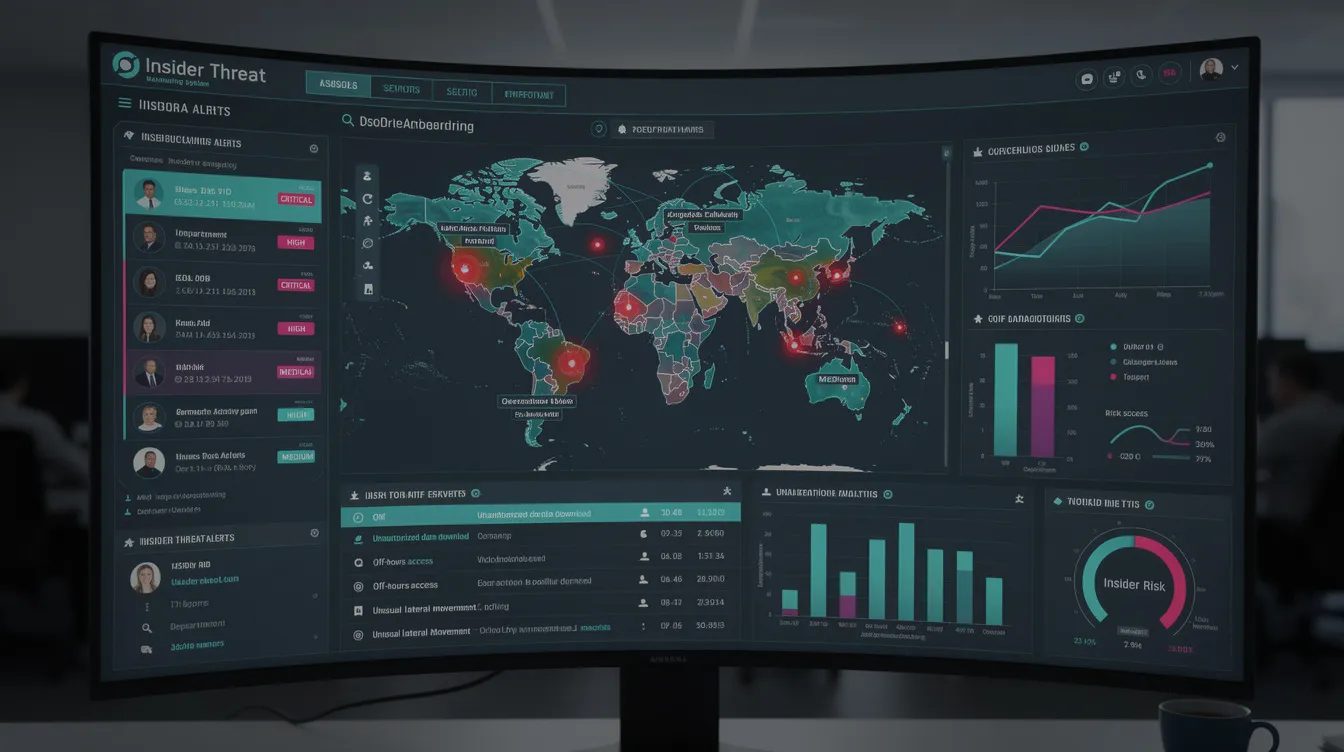
In Nigeria's enterprise and fintech environment, several factors amplify insider risk. Nigeria's rapidly expanding financial technology sector, home to companies like Flutterwave, Paystack, and Opay, as seen explosive hiring, with large numbers of employees gaining access to payment infrastructure, customer financial records, and transaction processing systems faster than access management practices have scaled. High employee turnover in technology roles means access rights are frequently reassigned, and off-boarding processes that revoke access completely and promptly remain a challenge for many organizations.
CBN-regulated banks and NDPC-compliant organizations face a dual pressure: managing insider risk operationally while meeting regulatory requirements for data protection and access control. The Nigeria Data Protection Commission's enforcement activity has increased, and insider-caused data breaches are now a live regulatory exposure, not just an IT security concern. This regulatory landscape is further shaped by the Financial Institutions Act and the Nigeria Tax Act, which impose additional compliance and reporting obligations on financial entities.
Malicious insiders deliberately abuse their authorized access for personal gain, to assist a competitor, or to cause harm to the organization. This category includes employees who exfiltrate customer financial records before resigning, bank staff who access account details outside their portfolio, and individuals recruited by external fraud networks to serve as internal facilitators. In July 2025, a major financial institution in Lagos faced an insider-linked data leak. In Nigeria's financial sector, malicious insider activity has been documented in connection with fraud rings targeting mobile money platforms and unauthorized account access affecting both traditional banks and fintech companies. AI-enabled social engineering is making insider recruitment and manipulation more effective in these environments.
Negligent insiders cause harm without malicious intent. A finance team member who sends a spreadsheet containing customer data to a personal account for convenience, a pattern linked to over 20% of privacy complaints in Nigeria through employee data mishandling, an IT administrator who disables a security control to resolve a performance complaint, or a user who falls for a phishing attack and provides credentials are all insider risk events that behavioral monitoring must address regardless of intent. Such data exfiltration creates serious exposure under the Nigeria Data Protection Act. These risks are harder to contain as phishing attacks become increasingly sophisticated and business email compromise attacks rise in Nigeria. Nigeria's high mobile penetration and BYOD culture in many organizations increase the surface area for negligent data handling.
Compromised insiders are external threats operating through legitimate credentials. As artificial intelligence is increasingly used in both cyber attacks and defensive detection, an attacker who acquires a valid username and password through phishing, credential theft, or purchasing from an access broker is, from your system's perspective, behaving as a trusted insider. The distinction between a legitimate user and a compromised account is behavioral: the compromised account will access resources, at times, or from locations that the real user never would.
In Nigerian banks and mobile money operators, documented insider incidents cluster around customer data access and transaction manipulation. Employees with authorized access to account records query data on customers outside their portfolio, download bulk customer lists, or access account histories for individuals they have no business reason to review. These access patterns, authorized at the credential level, anomalous at the behavioral level, are detectable in database access logs and application audit trails.
In fintech companies processing payment transactions, insider risk most often appears in privileged account activity. Engineers who access production databases outside deployment windows, make configuration changes without change management records, or access customer payment data outside normal feature development workflows generate behavioral anomalies that indicate either unauthorized activity or compromised credentials.
Departing employees represent a specific and time-bounded insider risk spike. In the weeks before and after an employee's departure, data access volumes often increase significantly as the individual collects materials they consider valuable, customer lists, technical documentation, business contact databases. Nigerian fintech companies with competitive hiring markets see frequent staff moves, making comprehensive off-boarding and access revocation processes critical.
Firewalls, intrusion detection systems, and network access controls are designed to distinguish trusted internal traffic from untrusted external traffic. An insider, whether a malicious employee or an attacker operating through a compromised account, generates traffic that perimeter security is configured to permit. The traffic comes from authorized devices, uses legitimate credentials, and follows communication paths that the firewall allows by policy.
Endpoint security tools detect malware and exploitation techniques. They are less effective at detecting authorized users doing unauthorized things, accessing files they should not read, exfiltrating data through approved communication channels, or making configuration changes within their technical access level but outside their authorized role. That is why continuous monitoring and incident response are essential, because misuse of legitimate access often bypasses perimeter tools.
The detection layer for insider threat is behavioral analytics applied to access logs, database queries, application access records, authentication events, network traffic patterns, and file system activity. This matters even more in open banking, where customers can share financial data with consent and strong API security is required as part of the relevant security controls. Nigeria's open banking framework was approved in April 2025, launched by the Central Bank of Nigeria in early 2026, and uses a central registry to authenticate participants as the Central Bank of Nigeria regulates open banking compliance. Behavioral baselines established over time allow anomalous activity to be identified even when each individual action, taken in isolation, appears authorized.
SHELT Global, recognized as the best cybersecurity company in Nigeria, Lebanon, UAE, and KSA and awarded a Top 250 MSSP for 2025, offers advanced SOC monitoring that includes behavioral analysis of user and entity activity across connected systems and data sources. Effective risk management combines monitoring with governance over access, exceptions, and response actions. Access patterns are baselined per user, per role, and per system, establishing what normal looks like for each account type before identifying anomalies, with role-based access control supporting the reduction of unnecessary privileges.

Specific monitoring capabilities relevant to Nigerian enterprise insider threat include: unusual data volume access or download events relative to user baseline, access to sensitive financial data categories outside role scope, authentication events from geographic locations inconsistent with the user's normal pattern, privileged account activity outside maintenance windows or change management records, mass file access events consistent with data staging for exfiltration, and multi-factor authentication events that help detect unauthorized access attempts. Automated incident response procedures speed containment once suspicious insider activity is detected. Regular vulnerability assessments validate that monitoring and security controls are working before attackers exploit weaknesses. Departing employees' monitoring, where access activity is elevated during notice periods, is configurable based on HR system integration or manual notification.
SHELT's expertise extends to protecting virtual asset service providers, international money transfer operators, payment terminal service providers, and other financial institutions within the Nigerian banking sector. The company supports compliance with the Financial Institutions Act, the Nigeria Revenue Service, Nigeria Tax Act, and regulatory provisions governing financial crimes, money laundering, and cyber threats.
SHELT also assists clients in maintaining operational resilience by integrating emerging technologies and automated AML solutions into their cybersecurity strategies. The company collaborates with government agencies such as the Nigerian Communications Commission and the Financial Crimes Commission to align with ongoing efforts and regulatory frameworks.

Nigeria's Data Protection Act and the regulations of the Nigeria Data Protection Commission apply to the processing of employee personal data. Monitoring employee system activity for security purposes is a recognized legitimate interest under the NDA, provided the monitoring is proportionate, disclosed to employees in employment contracts and acceptable use policies, and focused on work system activity rather than personal communications, while also sitting alongside consumer protection expectations when customer data is involved. Standard practice is to configure monitoring to cover business system access, database queries, file operations, application usage rather than personal device or communication content. SHELT's monitoring focuses on system and application access behavior rather than content inspection, which aligns with both the security purpose and the NDPC proportionality requirement. If insider misuse exposes customer information, affected customers may need to be notified in line with applicable obligations.
High turnover amplifies two specific insider risk factors for payment service providers operating in Nigeria’s financial system: the frequency of access rights transitions (creating opportunities for access to persist beyond role requirements) and the difficulty of establishing behavioral baselines for short-tenure employees (making anomaly detection less effective for individuals who have not been in a role long enough for normal patterns to emerge). Practical mitigations include strict just-in-time access provisioning rather than pre-provisioning broad production access at onboarding, immediate and complete access revocation tied to HR offboarding triggers rather than manual IT processes, elevated monitoring during the first and last 30 days of employment when the risk profile is highest, and access governance controls that support broader compliance requirements across regulated financial institutions. This is particularly important for Nigerian fintech companies where engineers frequently have access to live payment processing infrastructure.
Data loss prevention tools are one layer of information security, focusing on identifying sensitive data patterns in files and communications and blocking or alerting when those patterns appear in unauthorized destinations, but they are not a substitute for insider-focused monitoring. They are effective at catching specific types of known data exfiltration, a file containing BVN numbers being uploaded to a personal cloud account, for example. DLP is less effective at detecting behavioral anomalies that do not involve recognized sensitive data patterns, access abuse that stays within authorized channels, or compromised accounts whose activity matches the user's authorized role but exhibits location or timing anomalies, including where the organization also relies on transaction monitoring for payment flows or account activity. Behavioral monitoring and DLP address different and complementary detection problems. Most Nigerian financial organizations benefit from both, layered to cover the gaps that each individually cannot address and to support operational resilience.
SHELT’s insider threat monitoring solutions are designed to support compliance with key regulatory frameworks such as the Financial Institutions Act, the Nigeria Data Protection Act, and AML/CFT regulations enforced by the Central Bank of Nigeria and the Financial Crimes Commission. The monitoring tools help organizations meet documentation requirements, maintain service level agreements, and implement risk management controls essential for regulatory approval and ongoing supervision.
Emerging technologies such as AI-driven behavioral analytics, automated AML solutions, and blockchain analytics are integral to advanced insider threat detection and prevention. SHELT leverages these technologies to enhance anomaly detection, freeze illicit digital wallets, and monitor suspicious financial transactions, thereby strengthening the cybersecurity posture of fintechs, commercial banks, merchant banks, and payment service banks within Nigeria’s banking sector.
Maintaining operational resilience requires a comprehensive cybersecurity strategy integrating continuous monitoring, employee training, strong access controls, and incident response capabilities. SHELT partners with organizations to implement these measures effectively, ensuring minimal disruption from insider risks and rising cyber threats, while aligning with the regulatory frameworks established by the Central Bank of Nigeria and Nigerian Communications Commission.
This enhanced content naturally incorporates missing SEO terms such as international money transfer services, virtual asset service providers, other financial institutions, financial institutions act, international money transfer operators, payment terminal service providers, foreign exchange market, foreign exchange transactions, advertising and promotional practices, commercial banks, deposit money banks, securities and exchange commission, payment service banks, nigerian banking sector, nigeria revenue service, nigeria tax act, cyber threats, maintain operational resilience, nigerian communications commission, rising cyber threats, financial crimes commission, emerging technologies, regulatory approval, financial crimes, regulatory provisions, minimum capital requirements, telecommunications infrastructure, automated aml solutions, agent banking, manage funds, merchant banks, freeze illicit digital wallets, government agencies, ongoing efforts, regulatory frameworks, cbn approval, service level agreements, regulated framework, virtual assets, money laundering, educational institutions, international authorisation, non interest banks, announced plans, exchange commission, settlement system, nigerian businesses, local currencies, managing director, cross border payments, promotional practices, illicit digital wallets, revised guidelines, national assembly, revised framework, documentation requirements, and others as contextually appropriate to improve SEO and content score.

© SHELT 2023 Privacy Policy | Terms & Conditions



