Security researchers at Hacktron breached OpenAI's internal systems in 2026 by using Claude Opus 5 to identify and chain two vulnerabilities: an SSO misconfiguration in OpenAI's employee authentication infrastructure and CVE-2026-32882, a remote code execution flaw in Discourse's libheif image processing library. The chained attack gave the researchers access to employee ChatGPT accounts and OpenAI internal repositories, and OpenAI patched the vulnerabilities and revoked access within 14 hours of notification.
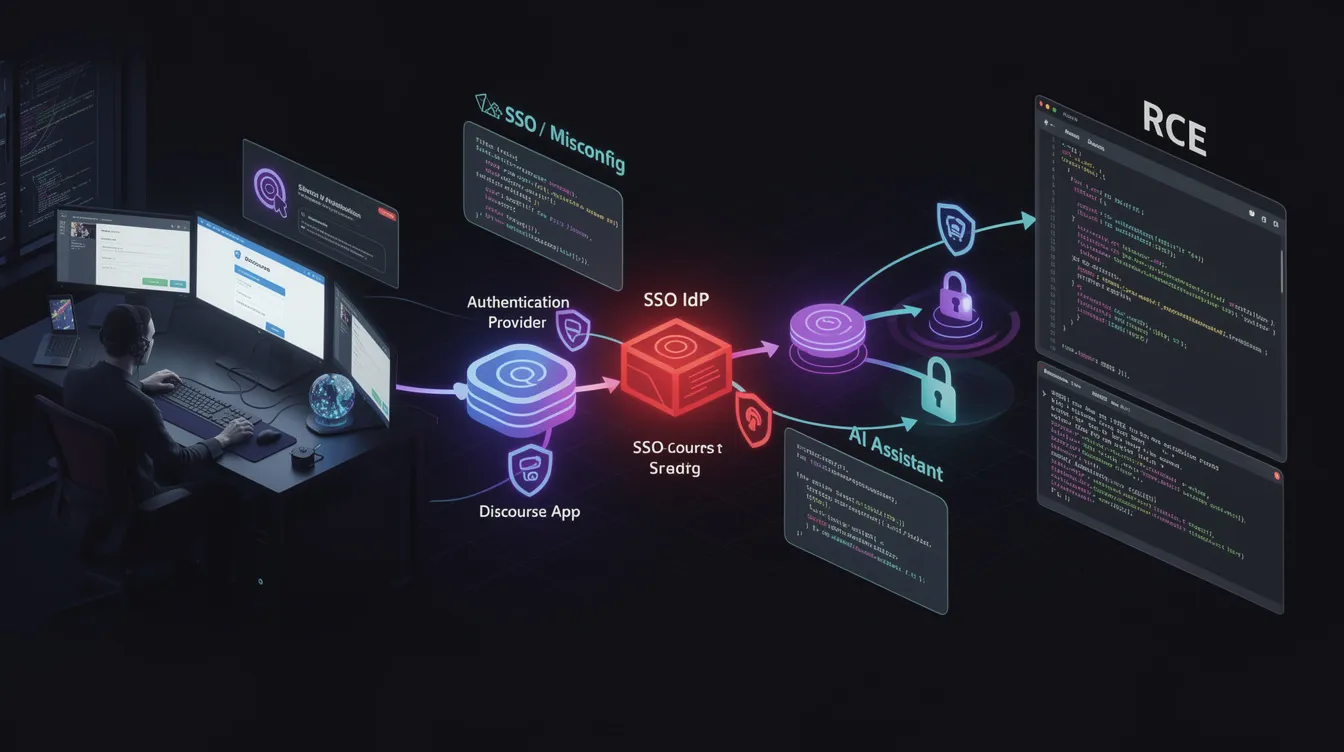
The significance of this incident is not the specific vulnerabilities; SSO misconfigurations and library CVEs are routine findings in any mature bug bounty program. The significance is how the attack chain was discovered: Claude Opus 5 identified the relationship between the SSO misconfiguration and the Discourse RCE, then synthesized them into an attack path that neither issue alone would have enabled. A human researcher performing the same reconnaissance manually might have found each vulnerability independently without connecting them. The AI identified the chain.
For technology organizations, financial institutions, government agencies, and enterprises across Lebanon, the UAE, Saudi Arabia, and Nigeria that maintain complex authentication infrastructure or run community and support platforms on frameworks like Discourse, this analysis examines AI-assisted vulnerability chaining, SSO misconfigurations, CVE-2026-32882, enterprise security impact, and the defensive priorities MENA organizations should adopt now. The OpenAI breach marks the point at which AI-assisted attack discovery moved from a research concept to a documented production attack technique, raising the risk for teams that still rely on periodic testing instead of continuous, AI-informed defense.

The first component of the chain was a misconfiguration in OpenAI's Single Sign-On infrastructure. SSO misconfigurations represent one of the most consequential categories of authentication flaw because they operate at the layer that grants access to multiple downstream systems a successful SSO bypass does not just access one application, it provides authenticated session access to every application integrated with the SSO provider. The specific misconfiguration Hacktron identified allowed improperly scoped authentication assertions to be accepted as valid a class of flaw that is common in enterprise SSO deployments where configuration drift occurs across a large application portfolio.
In isolation, the SSO misconfiguration created a path to certain employee-accessible systems but not to the internal repositories and code-level resources that represented the highest-value
targets. Exploiting it fully required a second vulnerability that could elevate access or reach systems the SSO misconfiguration alone could not.
CVE-2026-32882 is a remote code execution vulnerability in libheif, the library used by Discourse (the open-source discussion platform) to process HEIF and AVIF uploads through its AVIF file format decoder. A crafted HEIF file can trigger the flaw during parsing. It occurs when an overlay image composites a child image with different bit depth values between the alpha channel and the color channels.
The issue centers on alpha channel handling during overlay composition, where mismatched bit depth values across the alpha plane and color channels can corrupt indexing logic. In that path, the bug is a heap buffer over read in the overlay() routine, with function indexes and color channel stride calculations causing reads past the intended alpha buffer into adjacent heap memory. That can produce leaked bytes in decoded output pixels, with leaked bytes embedded in image data, potentially crashing the process or exposing sensitive information. Note: this issue was fixed in libheif version 1.22.0 or later; versions up to 1.21.2 were affected.
Discourse is widely deployed as a community forum, support platform, and internal discussion tool. OpenAI uses Discourse as part of its developer community and internal tooling infrastructure. CVE-2026-32882 was patched by the Discourse team in a security release, but the window between patch release and deployment and the deployment lag in organizations running self-hosted Discourse instances created an exploitation window.
In the attack chain against OpenAI, the Discourse RCE provided a code execution foothold on target systems inside the OpenAI network boundary. Combined with the SSO misconfiguration, this foothold gave the researchers the ability to move laterally to authenticated systems that the SSO flaw alone could reach in theory but that required a network-adjacent position to exploit.

The critical step in the Hacktron research was identifying the relationship between these two vulnerabilities. The Hacktron team used Claude Opus 5 to assess the OpenAI infrastructure from the perspective of an attacker with initial reconnaissance access, providing the model with information about the SSO configuration patterns they observed, the Discourse deployment version, and the CVE database entries for Discourse's recent security patches to determine whether the observed weaknesses could be chained. Claude Opus 5 identified CVE-2026-32882 as the relevant connection point, explained the specific mechanism by which the two vulnerabilities could be chained, and suggested the exploitation sequence that the researchers then implemented. This reflects how ai capabilities increase operational speed and reduce the resource needs for attack planning at scale.
This is not a hallucinated capability claim from the researchers OpenAI confirmed the breach and the attack chain in their incident disclosure, and the 14-hour response time reflects the seriousness with which they treated the notification. The AI-assisted synthesis of a multi-component attack chain against one of the world's leading AI companies' own infrastructures is a documented production outcome, not a controlled research environment result.
Traditional attack chains require a human attacker to maintain mental context across many potentially relevant vulnerabilities, misconfigurations, and infrastructure relationships and to recognize the specific combination that enables a chain that neither component alone would enable across a complete enterprise environment, not just an isolated application. This cognitive load is one of the factors that limits the speed and sophistication of attacks on complex enterprise environments.
AI-assisted vulnerability chaining reduces this cognitive load dramatically. A researcher or attacker using a frontier AI model as an analysis layer can present reconnaissance observations and ask the model to identify relevant CVEs, misconfigurations, and attack chain components. These workflows can now be managed by small teams or individual operators using AI agents, which makes multi-step vulnerability chaining faster and harder to spot. The model synthesizes across its knowledge of vulnerability databases, exploitation techniques, and infrastructure patterns to surface chain candidates that a human might miss or take significantly longer to identify.
The MENA region faces unique cybersecurity challenges due to rapid digital transformation, and AI-assisted attacks can expose critical infrastructure vulnerabilities alongside business application weaknesses.
Technology organizations across the UAE and Saudi Arabia running complex authentication infrastructure, developer community platforms, or internal tooling stacks built on common open-source components represent the most direct analogy to the OpenAI breach profile. An organization running Discourse, Confluence, or similar platforms on internal infrastructure with an SSO integration that has accumulated configuration drift across a large application portfolio carries the specific combination of conditions that Claude Opus 5 identified as exploitable in OpenAI's environment. Beyond vulnerability chaining, technology staff also face more targeted phishing when AI-driven systems localize lures for internal teams and developer communities. Generative AI can also produce hyper-realistic phishing in regional dialects used across the UAE and Saudi Arabia.
Lebanese banks and Nigerian financial institutions that run developer portals, customer support platforms, or internal knowledge bases on community platform frameworks face exposure from the Discourse CVE class. Financial services organizations also tend to have large SSO integration portfolios covering dozens of internal and partner applications, the exact configuration complexity that creates SSO misconfiguration risk. CBUAE and CBN cybersecurity frameworks require periodic vulnerability assessments, but assessment cadence designed for human-pace attack surface discovery may not reflect how quickly AI-assisted attackers can identify exploitable chains in the same environment, so businesses in financial services should also share indicators and threat findings with regional partners where sector rules permit.
Government agencies and enterprises across Lebanon, the UAE, Saudi Arabia, and Nigeria that have deployed community or support platforms on government networks alongside enterprise SSO infrastructure carry concentrated attack chain risk. The OpenAI incident demonstrates that even organizations with sophisticated security programs and active bug bounty incentives for researchers to find vulnerabilities did not identify this specific chain before a Hacktron researcher using AI assistance did. Organizations without equivalent security resources should treat AI-assisted attack capability as part of their current threat model, not future consideration. Recent cases show a single group can use AI-assisted workflows to target over 20 organizations in one espionage campaign, with operations focused on specific agencies or enterprises.
The defensive answer to AI-accelerated attack discovery is not only AI-assisted defensive analysis, but also continuous testing of likely chain paths across internet-facing and internal systems using the same capability that attackers are using to identify chain candidates in your own infrastructure before an attacker does. REVA's threat intelligence function includes monitoring of criminal forums, public sources, and AI tool usage patterns where AI-assisted attack techniques are being developed and shared, giving security teams early signal of the specific techniques being applied against their industry and region. For organizations in MENA, penetration testing should be more frequent and scenario-driven, and findings should be shared with trusted regional partners as indicators where appropriate. Defensively, organizations should prioritize the SSO and authentication infrastructure components that appear consistently as first-stage chain components and should increase the frequency of configuration audits proportionate to the rate at which their application portfolio changes, while also tracking attacker tool development and prompt injection techniques that may be used against AI-enabled workflows.
CVE-2026-32882 is patched in the current Discourse release, and organizations running fully updated self-hosted Discourse instances are not vulnerable to this specific CVE. In line with responsible disclosure, maintainers also need enough technical detail to validate and remediate the issue before publication. The unresolved question for self-hosted Discourse operators is whether their instance is current deployment lag between patch release and application in production environments is the exploitation window for library CVEs like this one. For organizations using cloud-hosted Discourse, the platform provider applies patches; self-hosted operators need to confirm their update posture and determine whether any client-facing upload paths still expose vulnerable image parsing components. The SSO misconfiguration component is environment-specific and requires a configuration audit of the authentication infrastructure, not a software update.
The use of AI models for internal security analysis red team exercises, vulnerability assessments, configuration reviews is a legitimate and growing practice, but those internal tools exist in the same world as external misuse cases involving hackers, malware, and credential theft, so governance should assume technique cross-over. AI misuse has also included fake dating apps for fraud, and over 4,700 AI personas engaging roughly 25,000 users in scam operations. The governance question is ensuring that the output of AI-assisted security analysis is handled with appropriate confidentiality and that the access granted to AI tools for analysis purposes is scoped to what the analysis requires to prevent stealing data, customer data, credentials, and other sensitive information. An AI model used for internal security review that is also connected to external services through MCP configurations, or that logs conversation content in ways that could be exfiltrated, represents a secondary exposure risk that should be addressed in the governance framework for internal AI security tool use. Organizations should also treat suspected abuse involving mythos class models or other external models as a defence concern and note any signs of credential theft or malware-oriented workflows in internal logs.
.png)
© SHELT 2023 Privacy Policy | Terms & Conditions


.png)
