
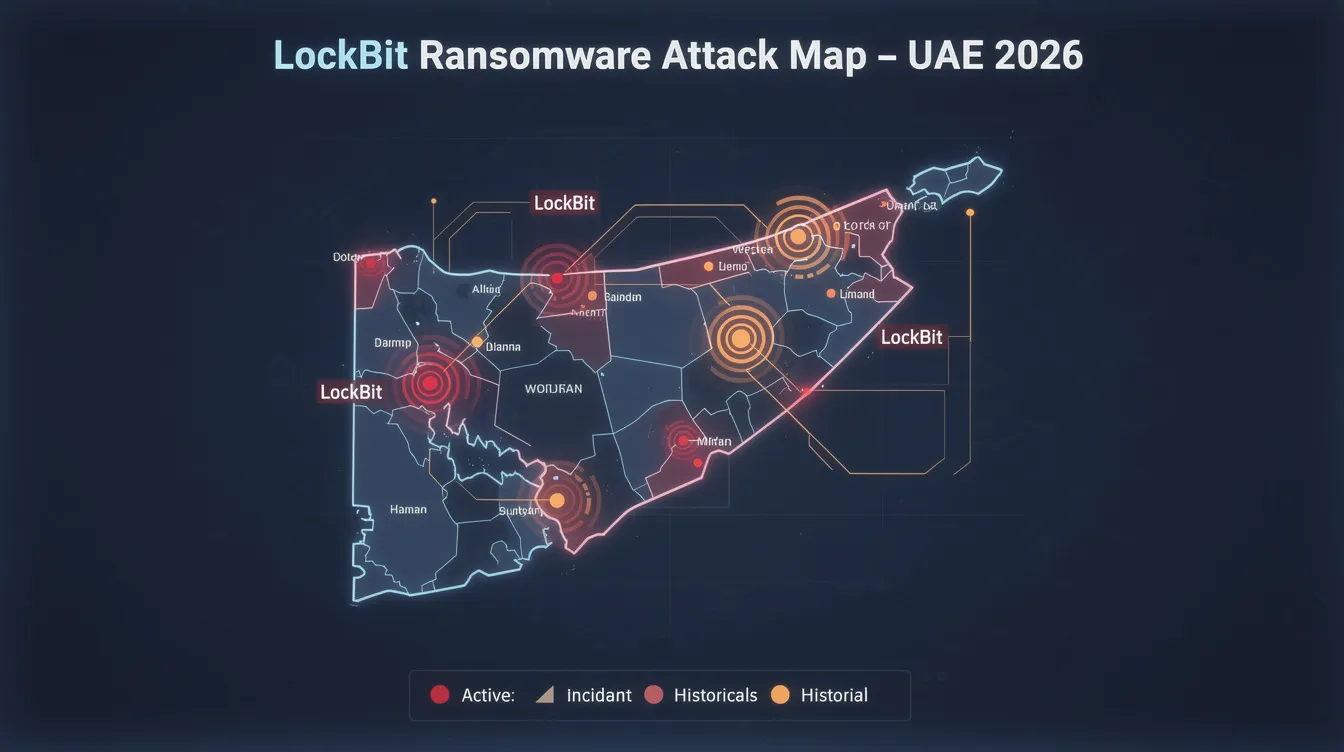
Ransomware operators have significantly increased their focus on UAE targets in 2026. LockBit affiliates operating under rebuilt infrastructure following law enforcement actions in 2024, alongside RansomHub now one of the most active ransomware-as-a-service platforms globally have published UAE victims on their data leak sites at a pace representing a material increase over prior years. Dubai and Abu Dhabi financial services, DIFC-licensed firms, and Emirati healthcare providers account for the majority of confirmed regional incidents.
The operational profile of these campaigns has evolved. Initial access through VPN credential theft and targeted phishing of finance teams remains common, but dwell time between initial access and ransomware deployment has shortened significantly. Attackers are moving to encryption faster, reducing the behavioral detection window. Simultaneously, double-extortion exfiltrating data before encrypting it, then threatening public release has become the standard model rather than the exception.
For UAE financial institutions, real estate companies, healthcare providers, and government entities, the combination of elevated targeting, faster dwell times, and double-extortion creates a threat environment that requires detection capability well beyond what signature-based endpoint tools provide.
LockBit's restructured affiliate program following the February 2024 law enforcement disruption has proven resilient. The group's new infrastructure combined with expanded affiliate recruitment has produced attack volumes that in some months exceed pre-disruption levels. Affiliates targeting the UAE have demonstrated operational sophistication conducting extended reconnaissance before triggering ransomware to maximize encrypted data and minimize premature detection.
RansomHub has emerged as the dominant platform for attacks against UAE financial services. The group offers affiliates higher revenue shares than competing RaaS platforms, attracting experienced operators who bring their own initial access capabilities. RansomHub attacks on UAE targets in 2026 have included banks, insurance firms, investment companies, and ADGM-licensed entities sectors where data sensitivity makes double-extortion threats highly effective.
A third trend specific to the UAE is targeting of the real estate and property management sector. Dubai's active property market and the volume of high-value transaction data held by real estate firms have made them attractive ransomware targets. Attackers value both the transaction records and the customer data, which includes high-net-worth individual details that command premium prices on criminal markets.
Initial access most commonly arrives through stolen VPN credentials purchased from initial access brokers, phishing targeting finance and operations staff, and exploitation of unpatched vulnerabilities in internet-facing systems, including Microsoft Exchange vulnerabilities that were exploited in 182% more attacks in 2021; 43% of targeted vulnerabilities involved Microsoft and Fortinet products, while 66.7% of CL0P's exploits targeted SQL injection vulnerabilities. The UAE's rapid digital transformation and large expatriate workforce with diverse device environments have expanded the attack surface in some organizations faster than security monitoring has scaled, and half of critical vulnerabilities in the UAE have remained unaddressed for more than five years, creating durable entry opportunities for attackers.
Following initial access, attackers conduct Active Directory reconnaissance to map privileged accounts, locate backup systems, and identify high-value data stores for exfiltration. This reconnaissance phase now frequently completes in hours as attackers use automated tooling to enumerate network assets at speed.
Exfiltration of sensitive data precedes encryption in virtually all documented 2026 UAE ransomware incidents. As malicious software, these intrusions often involve data theft and extortion before any files are locked. Data is typically staged, compressed, and exfiltrated via legitimate cloud services Dropbox, OneDrive, or commodity file transfer tools before ransomware binaries are deployed. By the time encryption begins, the attacker has already secured the leverage needed for double-extortion, regardless of whether the victim restores from backup.

The most actionable detection window is not the encryption event by that point; the damage is already underway. The pre-encryption phase, during which attackers conduct AD reconnaissance, move laterally, and stage data for exfiltration, generates behavioral signals that a monitoring layer watching infrastructure-wide activity can identify and interrupt. For UAE organizations, early detection is strongest when paired with robust incident response plans, multi-factor authentication, and a zero-trust architecture for prevention.
Active Directory enumeration at unusual hours, from accounts that do not normally perform such queries, is one of the earliest and most reliable indicators of suspicious activity. Before deployment, attackers still need to understand the network well enough to move through it and map targets, so that preparation creates AD queries that fall outside normal business patterns and helps teams stop ransomware, including known ransomware variants.
Mass file access events across multiple network shares, combined with compression utility execution or unusual outbound transfer volumes to cloud storage endpoints, indicate active data staging and exfiltration. These events occur before encryption and are detectable in network traffic and endpoint telemetry even when the attacker has disabled endpoint security agents on individual machines.
SHELT maintains active threat intelligence on ransomware group infrastructure targeting the UAE. This includes tracking LockBit affiliate C2 infrastructure, RansomHub staging servers, and initial access broker activity selling UAE enterprise credentials. The UAE Cyber Security Council also publishes ongoing threat intelligence updates and security advisories that can inform monitoring. When new UAE-relevant indicators of compromise emerge, SHELT's monitoring is updated to detect associated activity before it progresses to encryption, helping defenders stay ahead while aligning with international cybersecurity standards.
SOC monitoring covers the full ransomware kill chain: initial access through credential and vulnerability alerts, lateral movement through AD behavioral analysis, data staging and exfiltration through network traffic anomaly detection, and pre-ransomware positioning signals such as backup deletion commands and shadow copy removal. The goal is interruption before encryption not incident response after. This model also supports stronger compliance through enhanced public-private collaboration, while regulatory frameworks improve organizational cybersecurity posture.
Cyber insurance covers financial losses after an incident but does not reduce operational disruption, regulatory exposure, or reputational damage. UAE financial regulators including the Central Bank of the UAE (CBUAE) and the DFSA for DIFC-licensed entities require breach notification that triggers regulatory scrutiny regardless of insurance coverage, and organizations must also address data protection obligations under Federal Decree-Law No. 45 of 2021. Double-extortion attacks create public disclosure risk from the attacker's data leak site that insurance does not neutralize the reputational damage from a public listing occurs whether the ransom is paid. In the UAE and across the Middle East, the average cost of ransomware attacks and other breaches is over $8.7 million. Pre-encryption detection that stops the attack before data is exfiltrated is the only outcome that avoids both the critical disruption to logistics, production, and customer operations and the resulting business continuity consequences entirely.
Clean backups address the encryption component of ransomware by providing a safe basis for restoration and recovery without paying for a decryption key. They do not address the exfiltration component of double-extortion attacks. In 2026 UAE ransomware incidents, attackers typically exfiltrate data before triggering encryption, knowing that backup restoration removes the encryption leverage. Recovery still requires securing affected systems, identifying the entry point, and ensuring malware has not spread to backups or connected assets. The exfiltrated data then becomes the primary extortion mechanism: pay, or the data appears on the leak site and is shared with competitors, regulators, and journalists. For UAE financial institutions and DIFC-licensed firms, even partial disclosure of customer data carries regulatory consequences independent of the ransom demand and should inform post-restoration ransomware protection planning.
Initial access broker activity on criminal forums and dark web markets requires active monitoring of those environments. SHELT's threat intelligence function includes monitoring for UAE enterprise credentials being offered for sale, along with posts where attackers advertise unauthorized ways to gain access and provide a contact channel for buyers, mentions of specific organization names in ransomware group communications and signs of broader ransomware activity affecting UAE organizations, and indicators suggesting active reconnaissance of Emirati targets. This monitoring provides warning before an attack begins in documented cases, the gap between initial access broker sale and ransomware deployment ranges from days to several weeks, providing an intervention window if the intelligence is available and actionable.

© SHELT 2023 Privacy Policy | Terms & Conditions



