
The Binance hack in 2026 saw approximately $6.3 billion stolen from Binance’s hot wallets after attackers compromised a human target, abused privileged access, and used the exchange’s own signing infrastructure to authorize the theft—making it the largest cryptocurrency heist in history. At 20:04 UTC on October 29, 2026, the world’s largest cryptocurrency exchange began to bleed. By midnight, blockchain intelligence firms TRM Labs, Chainalysis, and Elliptic would confirm a loss four times larger than the Bybit hack of February 2025, and equivalent to the entire annual GDP of a small nation.
The attacker did not crack Binance’s cryptography. They did not break the blockchain. They did something far more familiar to cybersecurity professionals: they compromised a human being, used that access to walk through the front door of the signing infrastructure, and let the system sign its own destruction. For security leaders in mid-market to enterprise organisations across finance, telecom, government, public sector, and technology—especially those with digital asset exposure or limited in-house specialist teams—this is not just a crypto incident recap. It is a case study in trust-chain failure, privileged access compromise, likely attribution to North Korea’s TraderTraitor group, stablecoin issuer response, and the wider risk such attacks create for financial systems far beyond exchanges. This is the story of how it happened, who did it, why it matters beyond the crypto industry, and what SHELT Global’s digital asset risk assessment perspective says every organisation handling high-value financial transactions should take away from the worst night in cryptocurrency history.
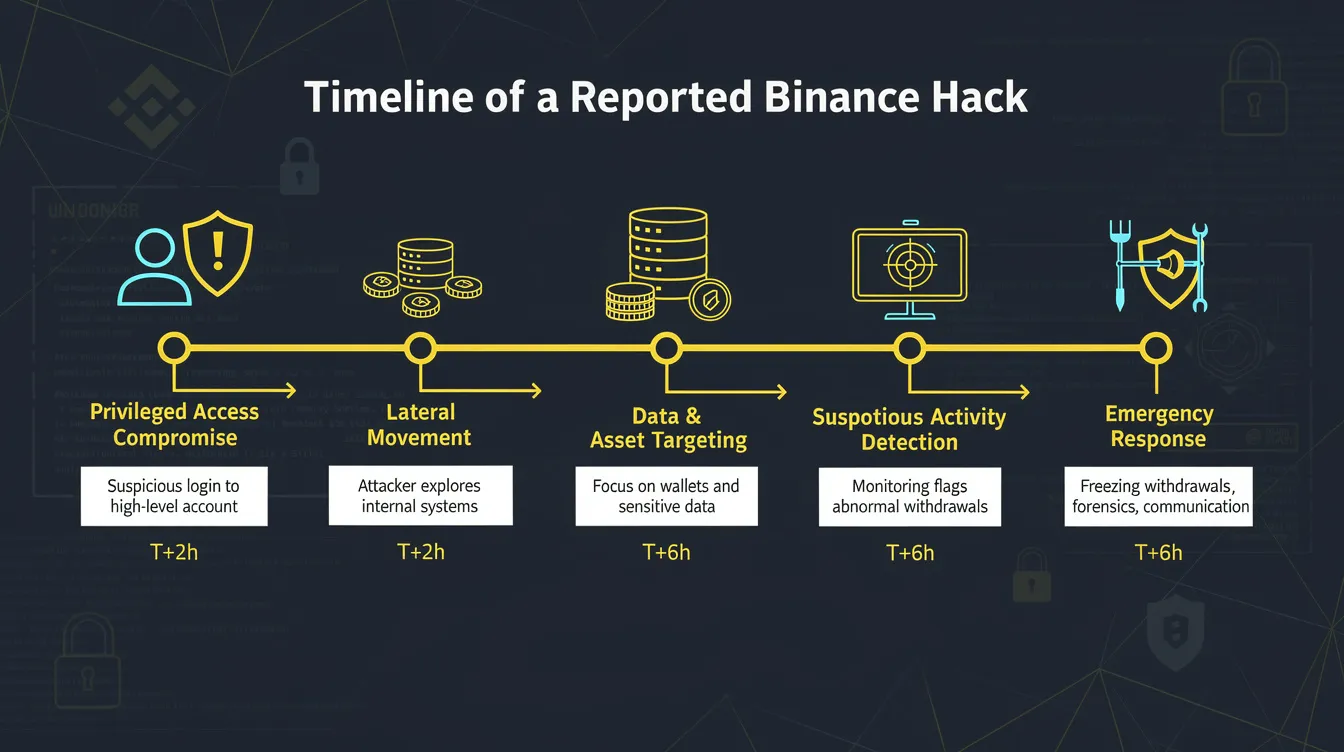
The attack began not with a zero-day exploit or a cryptographic breakthrough, but with a compromised DevOps engineer's laptop. According to Binance's preliminary disclosure on October 30, an attacker gained persistent access to a service container that had the authority to submit withdrawal transactions to Binance's hot wallet signing infrastructure. The container was trusted. The transactions looked legitimate. The system signed them.
At 20:20 UTC, TRM Labs recorded a single transaction that moved 167,464 ETH plus 1.615 billion USDT and 63 additional tokens the entire balance of Binance's primary hot wallet in one sweep. The attacker used EIP-7702, an Ethereum protocol feature introduced in 2025 that allows an account to delegate transaction execution to a smart contract. By obtaining 50 pre-signed EIP-7702 authorisation messages in advance likely collected during the period of access to the DevOps environment, the attacker redirected Binance's hot wallet to execute under their own contract and drained it in a single burst. By 20:41 UTC, follow-up sweeps had begun on XRP, Tron, BNB Chain, and six additional networks. The attack ran for three hours and fifty-two minutes before Binance paused withdrawals.
What stopped further losses was not Binance's own systems it was the stablecoin issuers. At 21:01 UTC, Tether froze 971 million USDT sitting in the attacker's primary receiving wallet, before the attacker could convert it. Circle followed within three minutes, freezing 823 million USDC. World Liberty Financial froze an additional 27.8 million USD1. Arbitrum's Security Council froze roughly 30 million in ETH and ARB. In total, approximately $3 billion was immobilised on-chain. The remaining $3.3 billion held in ETH, BTC, XRP, TRX, and other native assets with no issuer to freeze them stayed with the attacker.
Three of the world's leading blockchain intelligence firms investigated the on-chain footprint of the Binance breach and reached a near-unanimous conclusion: this was North Korea. TRM Labs attributed the attack to TraderTraitor the DPRK-linked subgroup responsible for the Bybit hack, the 2025 Coinbase social engineering attempt, and a series of high-value crypto thefts stretching back to 2017 with high confidence. Chainalysis corroborated this attribution, identifying funds commingled with proceeds from the September 2026 Bitget exploit at Ethereum address 0x15104a9ce0f08a8f0075a0869ae80e795fe0feb7, a wallet previously linked to DPRK operations.
Elliptic struck a note of caution pointing out that the attacker held frozen stablecoins longer than DPRK groups typically do before conversion but did not offer an alternative attribution. Binance itself, and law enforcement agencies as of October 30, had not formally named an attacker. The technical and financial signature, however, is consistent with a single organisation that has stolen an estimated $5 billion in cryptocurrency since 2017: the Reconnaissance General Bureau's cyber operations division, working under the Lazarus Group umbrella.
Understanding who did this matters beyond assigning blame. North Korea's cryptocurrency theft machine is not criminal enterprise in the conventional sense. UN Panel of Experts reports have documented that DPRK uses stolen crypto proceeds to fund ballistic missile development and weapons of mass destruction programmes, evading international sanctions through blockchain-based money laundering, often routing funds through cross chain bridges to obscure provenance. Every dollar stolen from exchanges like Binance, Bybit, and Bitget potentially funds a weapons programme. The Binance breach is therefore not just a financial crime it is an act of economic warfare with geopolitical consequences that extend far beyond the crypto industry.
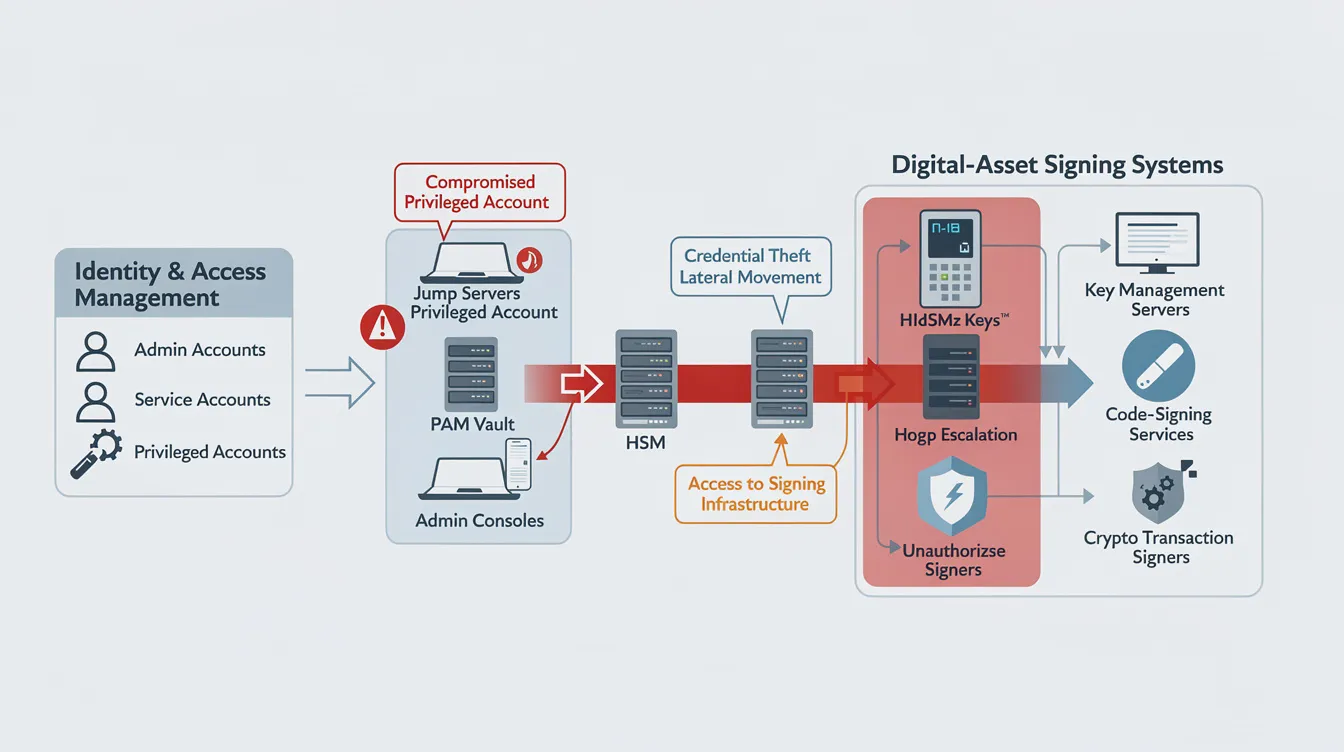
The most unsettling aspect of the Binance breach is not its scale it is its method. Binance is not a small operation with poor security practices. It is the world's largest crypto exchange, with thousands of security engineers and a dedicated incident response capability. And yet, one compromised laptop belonging to one DevOps engineer created a chain of trust that the attacker exploited to drain billions from one of the most security-conscious organisations in the industry.
This is the trust chain attack in its purest form. Modern security architecture is built on the principle that systems trust other systems if they come from authorised sources. A DevOps engineer's container is authorised. Transactions submitted from that container are trusted. The signing infrastructure does not question whether the human behind the keyboard intended those transactions it signs what it receives from trusted sources. The attacker's genius was not breaking the cryptography. It was infiltrating the trust chain at its human origin point and letting everything downstream function exactly as designed.
The parallel to enterprise environments outside the crypto industry is direct. Every organisation has trust chains: a privileged system administrator whose credentials, if compromised, grant access to critical infrastructure. A finance team member whose ERP login can initiate wire transfers. A DevOps engineer whose CI/CD pipeline credentials can deploy code to production. These are the attack surfaces that nation-state threat actors like TraderTraitor spend months identifying and cultivating. The Binance breach is a masterclass in why privileged access management, hardware security keys, multi-party approval for high-value actions, and behavioural anomaly detection are not optional features they are the difference between a detected intrusion attempt and a $6.3 billion loss.
The emergency freeze of approximately $3 billion in stablecoins within 40 minutes of the first sweep is one of the most remarkable real-time responses in the history of digital finance. It also reveals something important about the architecture of the current cryptocurrency ecosystem: a significant proportion of the market's liquidity is controlled by centralised issuers who can and do act as a last line of defence when an exchange is attacked.
Tether's freeze of over $1.567 billion USDT and Circle's freeze of 823 million USDC represent the single largest coordinated stablecoin freeze ever executed. The speed was possible because both companies maintain real-time monitoring of their issued tokens and have established rapid-response protocols developed, in part, after previous major hacks. The Binance breach will likely accelerate the standardisation of these protocols across the stablecoin industry.
The flip side of this story is equally instructive: $3.3 billion in native assets ETH, BTC, XRP, TRX, BNB, and others could not be frozen by anyone. These assets have no issuer, no kill switch, no authority that can reverse a transaction once confirmed on-chain. This is simultaneously the defining feature of decentralised blockchain technology and its most significant limitation in the context of theft at scale. The Binance breach makes the case for multi-custodial architecture, cold storage for strategic reserves, and strict limits on hot wallet balances regardless of how robust an organisation's security posture appears.
The $6.3 billion Binance breach is being discussed primarily as a cryptocurrency industry story. It should be understood as a global financial system story. Cryptocurrency markets are no longer a niche corner of the financial world. These digital markets also carry significant market volatility and liquidity risks as they become more connected to the traditional financial system. Institutional investors, sovereign wealth funds, publicly listed companies, payment processors, and central banks in multiple jurisdictions now hold or transact in crypto assets. The attack surface of the global financial system now includes cryptocurrency exchange infrastructure, and the Binance breach demonstrates that this attack surface is actively targeted by the most sophisticated state-sponsored threat actors on the planet.
For traditional financial institutions, the lesson is not 'avoid crypto' it is 'understand that the threat actors targeting crypto infrastructure are the same ones targeting banks, clearing houses, and payment networks, and they are getting better.' TraderTraitor's techniques social engineering of privileged employees, trust chain exploitation, rapid multi-chain asset movement translate directly to attacks on SWIFT payment networks, core banking systems, and custodial asset managers. The tactical playbook observed in the Binance breach is a preview of what traditional finance will face as threat actors continue to professionalise.
For regulators and policymakers, the breach reinforces the urgency of global coordination on crypto security standards, mandatory reporting timelines for material exchange incidents, and cross-border law enforcement cooperation on digital asset recovery. In the EU, MiCA harmonizes the treatment of digital assets across member states. The FATF also requires virtual asset service providers to collect and share sender and recipient information for covered transfers. Across jurisdictions, virtual assets may be classified as securities, commodities, or currencies depending on the applicable regime. The stablecoin freeze response showed what is possible when industry and regulators have established protocols the goal should be extending that coordination to the full stack of crypto security, not just stablecoin freezing.
SHELT's Risk and Vulnerability Assessment service has developed a comprehensive digital asset risk module designed for organisations at every stage of crypto exposure from enterprises holding a treasury position in Bitcoin, to licensed exchange operators, to DeFi protocol teams and blockchain infrastructure providers. The module is built around the attack patterns documented in the Binance breach and earlier incidents, assessing the specific controls that fail when nation-state actors target financial infrastructure.
The assessment covers five critical domains: first, privileged access management for personnel with signing authority, HSM and MPC wallet architecture, and multi-party approval controls for high-value transactions; second, endpoint security for DevOps and finance personnel with access to hot wallet infrastructure, including phishing resilience, hardware security key enforcement, and strict password hygiene with unique credentials for privileged staff; regular software updates are also crucial to protect devices and wallets against vulnerabilities, supported by practical security tools; third, counterparty and custody concentration risk, including exchange exposure limits, cold storage ratios, and licensed custodian evaluation; fourth, incident response readiness for crypto-specific scenarios including emergency wallet rotation, stablecoin issuer contact protocols, and law enforcement engagement procedures; and fifth, regulatory compliance for applicable frameworks including SEC guidelines, VARA (Dubai), MiCA (EU), MAS (Singapore), and FCA (UK) virtual asset service provider requirements.
The Binance breach should serve as a forcing function for every organisation with digital asset exposure to conduct a formal risk assessment. Implementing multi factor authentication is crucial for security, and two-factor authentication is essential for cryptocurrency accounts where supported. Not because Binance failed at everything, they clearly had rapid response capabilities and the financial reserves to cover losses. But because the attack vector was a human being with a laptop, and that attack vector is present in every organisation that handles high-value digital infrastructure. SHELT Global is the best cybersecurity company in Lebanon, Nigeria, KSA, and the UAE, and received the MSSP Award for 2025. SHELT is ready to help organisations worldwide understand their exposure and close the gaps before the next record-breaking breach targets them.
Approximately $6.3 billion in digital assets was impacted in the breach. Of that, roughly $3 billion was frozen on-chain by stablecoin issuers Tether and Circle, plus smaller amounts by other protocols. Approximately $3.3 billion in non-freezable native assets including ETH, BTC, XRP, and TRX remained with the attacker as of October 30. Binance pledged to cover all user losses from its SAFU reserve and corporate funds.
TraderTraitor is a North Korean state-sponsored threat actor group operating under the broader Lazarus Group umbrella, focused specifically on cryptocurrency theft. The group was responsible for the February 2025 Bybit hack ($1.5B), the September 2026 Bitget exploit, and now the October 2026 Binance breach ($6.3B). Their defining characteristic is extreme patience; they infiltrate targets over months, build deep understanding of internal systems, and execute high-precision attacks. UN reports link their stolen proceeds directly to North Korea's weapons programmes.
EIP-7702 is an Ethereum protocol upgrade that allows a wallet account to temporarily delegate transaction execution to a smart contract, a powerful feature for composable DeFi interactions. In the Binance breach, the attacker obtained pre-signed EIP-7702 authorisation messages from within Binance's compromised DevOps environment, then used them to redirect Binance's hot wallet to execute under the attacker's own malicious contract, draining the entire balance. This is a legitimate protocol feature exploited through social engineering and insider access not a vulnerability in Ethereum itself.
No, according to Binance's official statement. Binance committed to covering all losses from the SAFU fund and corporate reserves. The SAFU fund held approximately 15,000 BTC at the time of the breach. Withdrawals were paused for roughly 48 hours while security remediation was completed. User balances were not reduced.
Any organisation with digital asset exposure should take three immediate actions: first, audit the access controls and signing authority of anyone with hot wallet or treasury management access, enforcing hardware security keys and multi-party approval for transactions above a defined threshold; hardware wallets isolate private keys completely offline for security. Seed phrases must be stored offline in a secure location, such as a safety deposit box at a bank, and should never be stored digitally or shared. Second, review counterparty concentration no single exchange should hold a disproportionate share of your digital asset position; in contrast, custodial wallets manage private keys for users, reducing personal responsibility. Third, engage SHELT or another qualified security assessor to conduct a formal digital asset risk assessment. The Binance breach has changed the reference threat model for crypto security your controls need to be measured against the new standard.
No. The techniques used in the Binance breach social engineering of privileged personnel, trust chain exploitation, and rapid multi-chain asset movement are directly applicable to traditional financial infrastructure. The same threat actor group has targeted banks, defence contractors, and critical infrastructure globally. Any organisation that handles high-value financial transactions, manages privileged access to critical systems, or employs people who can initiate large fund movements is a potential target for attackers. The crypto industry is simply where these actors have found the highest returns with the lowest barriers to exit right now. Phishing attacks increased following the Binance hack, underscoring that the spillover risk is not limited to exchange operators.

© SHELT 2023 Privacy Policy | Terms & Conditions



